Sunday, May 01, 2011

Norwescon 34: The Future of My Past Was My Present

As of 1982, I had attended two conventions: The 5,000-attendee 1980 San Diego Comic-Con, which had made a huge impression on me and contributed to my eventual decision to live in Southern California; and the 1981 Moscon, a 300-attendee regional con in Moscow, Idaho, a couple of hours drive from my hometown. In the spring of 1982, with my parents' permission, I flew up to Seattle to stay with my sister while I attended the fifth Norwescon, the science fiction convention in Seattle. Norwescon was the first large convention I attended devoted primarily to science fiction. It drew world-class guests, including Artist guest of honor Michael Whelan, the leading SF and fantasy illustrator of the time (now he is pursuing fine art full-time); writer guest of honor Thomas Disch (who, horribly, committed suicide three years ago); fan guest of honor Bob Shaw, who came to the con from Ireland (he passed away in 1996). The attendance was 1,375, which seemed like a lot of people then. I dined at the con with friends I had made through Northwest fandom, and made a new friend, cartoonist Phil Yeh, whom I still chat with every year at Comic-Con.


Although I've attended dozens of conventions since then, my only other contact with Norwescon was a stopover in 1984 while I waited at SeaTac airport for a flight home for spring break.


That nearly thirty year Norwescon fast was broken last week, as Amy and I attended Norwescon 34, still held in SeaTac. There were two occasions for the trip. First, two of Amy's favorite fantasy writers, Patricia McKillip and Jim Butcher, were guests of honor, along with Butcher's wife, author Shannon Butcher, and fantastic illustrator Kinuko Y. Craft. Second, we got to spend several days with our friends Rick Marshall and Beverly Saling, whom we seldom see except when our travels take us to Seattle.


The fun started on the first day of the con, Thursday (despite the con losing our preregistrations). The con had revived the custom of holding a guest of honor banquet, at which the guests mingle with ticket-buyers. We sat at Ms. McKillip's table, and Amy got to sit next to Ms. McKillip as we dined with her and her husband.


Here's a photo of all the guests of honor, from the opening ceremonies later that day:


We also got to interact with the guests during the Saturday mass autograph session. Jim Butcher had a huge line that snaked around one side of the room. Meanwhile, Amy and I got autographs from the ever-gracious Ms. McKillip:


Kinuko Craft was drawing original illustrations in art books brought to her to autograph. The woman in front of me in line was incensed at this. "She doesn't seem to get that this isn't moving us through the line as fast as possible," my fellow line-stander griped. "I'd be satisfied with just an autograph." I marveled at a fan upset about receiving free art from a master illustrator. "You're welcome to ask her for just an autograph," I replied. "Sorry I offended you," she rejoined. Some people just want less, I suppose.

Attendance at the con was 3,500 -- way less than Comic-Con, or even the Sakura Con anime convention in nearby downtown Seattle -- but still a bit too many for the facility. The panels were often standing-room-only.

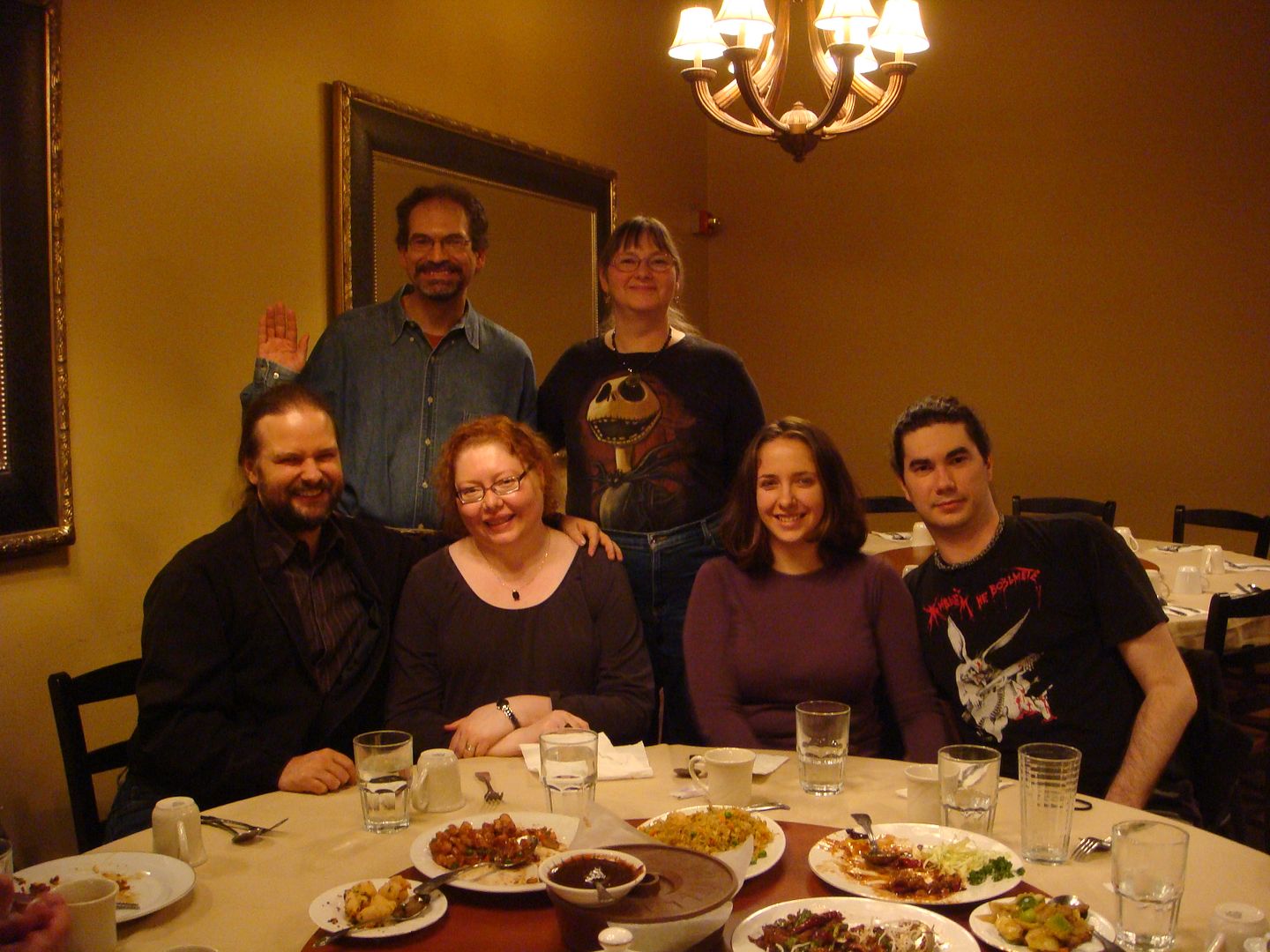
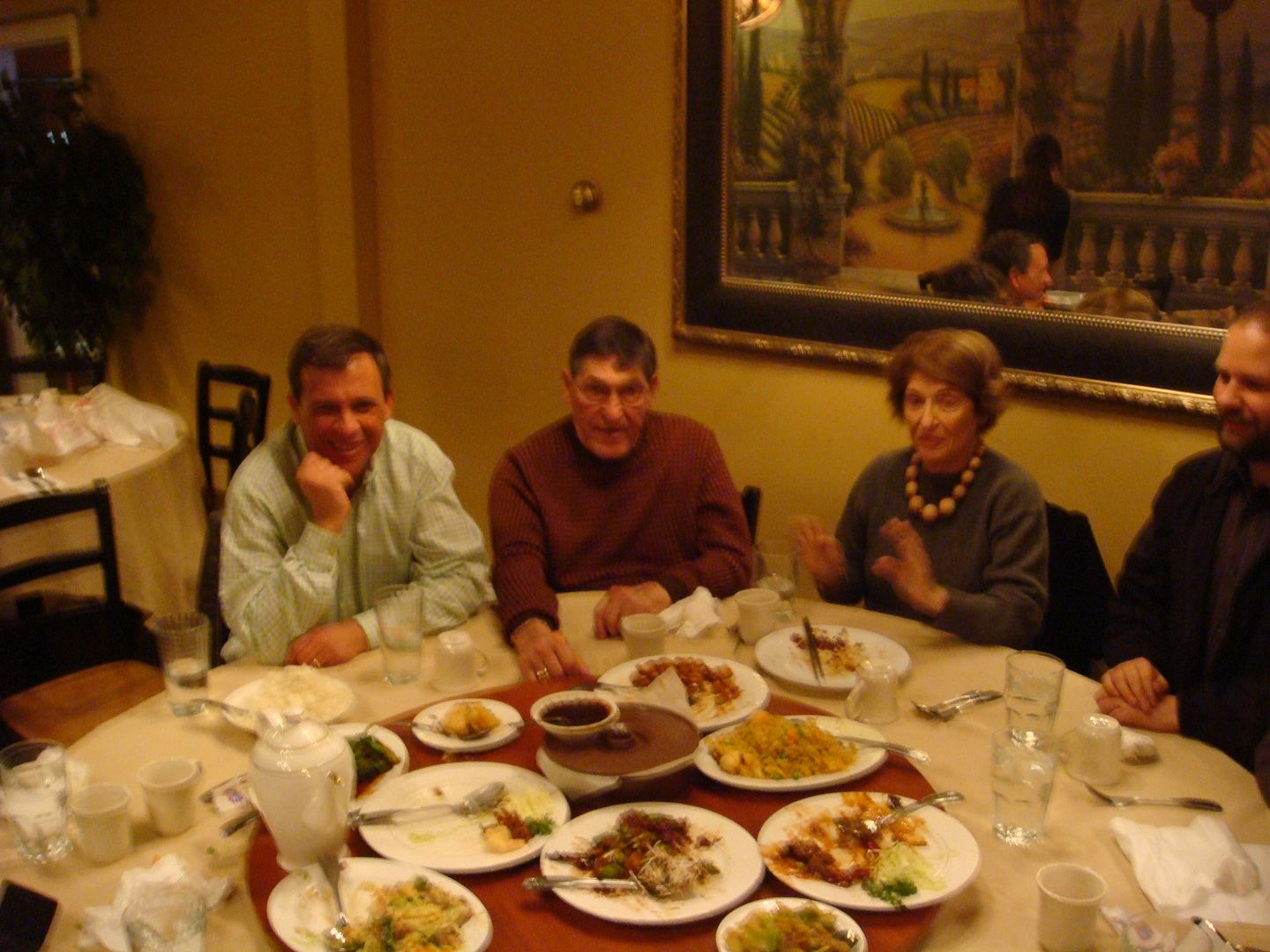
Sunday, the last day of the convention, happened to be my birthday. So Rick, Beverly, Rick's sister Jenny, her boyfriend, and members of my family went to a Chinese restaurant on Mercer Island for a birthday dinner.


Overall, we had lots of fun returning to the scene of my futuristic past.

Sunday, April 17, 2011

Soulless Tea


I have written in the past that I am impressed not only with the novels from the author who writes as Gail Carriger, but with her marketing savvy. Ms. Carriger has not only created a series of witty, entertaining steampunk fantasy books, the Parasol Protectorate (with "soulless" protagonist Alexia Tarabotti), but she has created an entire persona to go with it -- tea and fashion maven Carriger -- and works tirelessly to present that persona via blog, Twitter, and personal appearances.

Her efforts have paid off: In an era in which print sales of books are ebbing, the second and third books in her Parasol Protectorate series landed on the New York Times Bestseller list in 2010 -- quite a feat, especially when one considers they were her second and third novels ever published.

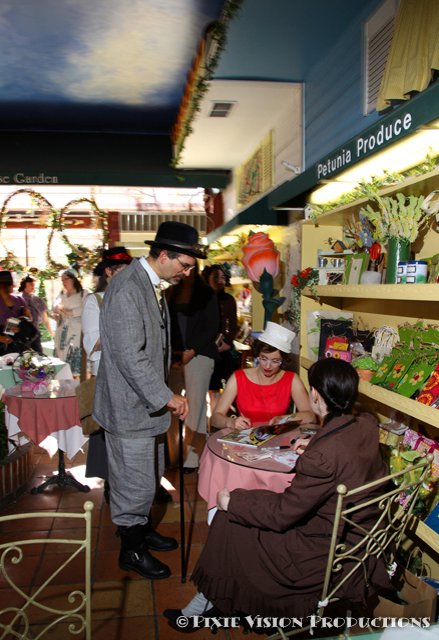
Last week, Amy and I had the pleasure of taking part in one of the events designed to promote Ms. Carriger's books: a tea held at a nice tea/rose house in Old Town Pasadena. The event sold out, and the rather small space was jammed with elegant outfits as folks sipped tea and nibbled on scones and finger sandwiches. Ms. Carriger made sure everyone at the tea had a chance to talk with her: She went table to table as people ate, and later set up a signing table in the middle of the room. In between, she read from the manuscript of the fourth book in the series, HEARTLESS (which comes out in July), and answered questions. If only all promotional events were this much fun.

(The photo of me is from Pixy Vision Productions, the official photographer for the event. All other photos are by me.)

Saturday, April 09, 2011

Even the Losers Get Lucky Sometimes

Even though Jack Kirby was best known for his superhero comic work (the genre that he revolutionized in the forties and the sixties), my first exposure to his comic book work was not a superhero comic. That's because before I began reading and collecting superhero comics, I was a big fan of DC's line of war comics. (I liked Marvel's SGT FURY AND HIS HOWLING COMMANDOS too, but even as an eight year old the DC war comics seemed to have more gravitas, with their brooding Joe Kubert covers and their "Make War No More" slogan in the last panel of every story.) So the first Kirby comic I ever bought, back in 1974, was what turned out to be his first work on the OUR FIGHTING FORCES comic feature, The Losers.

Last week, memories of that first encounter were brought back as I bought and read the hardcover collection of Kirby's LOSERS stories that was published two years ago.


In the introduction to the volume, Neil Gaiman notes that THE LOSERS was arguably the last great Kirby comics feature; and reading the stories nearly thirty years after their publication, I must agree. These weren't Kirby's characters (they were all former stars of their own strips who had lost their slots -- hence, perhaps, the feature's title)but Kirby had written and drawn many, many war comics before he worked on THE LOSERS -- including the aforementioned SGT. FURY. Artistically, Kirby was still at the top of his game, his panels loaded with the violent poetry that brought to life his Marvel work on THOR, FANTASTIC FOUR, and CAPTAIN AMERICA, along with the Fourth World books he did in the early seventies for DC. When Kirby draws a Nazi rail mounted Supergun, it looks gigantic, like it goes on for miles; when he depicts a town shelled by the allies, it looks as if hell itself is erupting out of the ground. In terms of writing, Kirby shed the quirks of weird dialogue and jarring punctuation that marked his other written work of the seventies and eighties. Instead, his dialogue is straightforward and rings true, even if stylized in comic book form.

And then there are the stories. As Gaiman points out, Kirby devoted little time to developing the main characters of the strip. Instead, his focus is on the side characters they meet -- the classical pianist who bangs out "Ride of the Valkyries" as the Nazi officer who was searching for her lies dying; the Jesse Owens-like Army supply officer who meets his rival from the 1936 Olympics, now a German paratrooper, and races him through a minefield; the science-fiction-fan private whose ideas are used for a decoy operation. Kirby is unstinting in depicting the Nazis as evil (after all, he and they fought each other during the real World War II); but he also approaches all of his characters as human beings, rather than caricatures.

I recommend THE LOSERS to anyone who knows Kirby only from his superhero work; or who thinks Kirby's strengths were only his art. It's excellent comics work.

Sunday, April 03, 2011

Birthday Party in Newcastle


Last weekend, we had the pleasure of attending my uncle Arnold Barer's 75th birthday, held at a magnificent venue in Newcastle, Washington overlooking Seattle and its environs.


Mother nature graced our brunch with a magnificent rainbow. Uncle Arny, ever competitive, pulled out his iPhone and showed me a picture he snapped of the much more impressive rainbow he'd seen from his house earlier that morning.


After the huge buffet, we were treated to speeches from Uncle Arny's friends and family, including one from my dad to his brother. (I don't know if the matching yellow sweaters were planned.)


Arny also endured some good-natured (I hope) roasting from his sons. Here's Sam, who enlisted Arny's grandkids into his plans.


Also present were my brothers (and fellow bloggers) Steve and Mike, along with their respective spouses.

We all had a great time. I hope that our family will continue to have milestone birthdays like this into the future.

Sunday, March 20, 2011

The Boys (and Girls and Men and Women and Little Kids) of Summer


I have a big recommendation for SUMMER WARS, the 2009 Japanese animated film recently released here on home video, with a spiffy English dub job written and directed by Patrick Seitz. Directed by Mamoru Hosoda, the director of the delightful THE GIRL WHO LEAPT THROUGH TIME, this science fiction tale of a math nerd who gets hauled out to the country on a hot weekend at the end of July 2010 for a questionable job, becomes embroiled in the reunion of a large and contentious extended family, and who helps endanger, and then save, the world is a delight from start to finish. Part of what makes this movie so impressive is the director's and animators' skill in making each of the many characters an individual, each with his or her own "voice," mannerisms, and outlook on life -- something difficult to do in live action, harder in animation, and even harder when dealing with the low budgets that even creators of feature-length animation labor under in Japan.

Electronic Pulp

A couple of decades ago, if you strolled by the little wire-rack shelves of paperbacks in the local drug store or supermarket, you'd probably see garishly-painted covers depicting grim-faced muscular men, blazing guns, exploding helicopters, and general mayhem, along with trade dress along the top that identified the book as number # in the adventures of Mack Bolan, The Executioner or Nick Carter, Killmaster or Remo Williams, The Destroyer or one of the other Man of Action series that proliferated from the '60s through the '80s.

Those books, along with the Harlequin Romances flanking them, were the paperback junk food of that time. In many ways, they were the evolution of the bloody-pulp heroes of the '30's. (Not surprisingly, reprints of those same pulp heroes' adventures, repackaged with spiffy cover art, were being sold alongside them.) Moreover, they were artifacts of an era in which far more people read novels. Along with the mystery lovers, and the science fiction fans, and the folks who read literature and bestsellers, there were ordinary guys, men who frequented bars and drove trucks and watched pro wrestling, who read books. For entertainment. And these were some of the books they read. Evidently in great quantities, because they were all over the place, clogging used book stores and book exchanges as readers tore through them and discarded them.


My cousin Lee Goldberg got his literary start in the 1980s writing one of those series, under the pseudonym Ian Ludlow. And now he has returned to his roots, as he and his TV writing partner Bill Rabkin have started THE DEAD MAN, a series of sinewy novellas starring brawny sawyer Matthew Cahill, written primarily for the ebook market that is supplanting mass-market paperbacks.

The first book, which I finished yesterday, is a traditional superhero origin story for Cahill, who dies in an avalanche and is resurrected by supernatural means. He picks up an infernal nemesis (who likely had a hand in his resurrection), the ability to determine who is about to commit evil, and a compulsion to do something about it with his trusty axe. The series features the dense boluses of sex and gory violence endemic to the genre. And just to show that the authors don't take this stuff too seriously, there's a running gag: The narrator takes random incidental characters, folks who will never appear again, and tells us the sordid details of their lives. (After illuminating one young woman's perversion, the narrator comments, "But you'd never know any of that looking at her and are probably sorry that you know it now.")


Some of the subsequent books will be written by Lee and Bill; others will be written by guest authors, including Lee's uncle Burl Barer.

I'm not sure if the return of the Man of Action genre will encourage the working-man audience of those books to return. More likely the audience will be fans of pulps, tough-guy literature, supernatural thrillers, and the nostalgic.

As for me, well, the authors decided to name Cahill's former employer after our former family business, B. Barer & Sons. So the word "Barer" appears about 10 times in the first book. One way to get me to read a book is to repeatedly mention my name.

Saturday, March 12, 2011

My Thoughts Are With Japan


Ever since early Friday morning, when the first horrific images of the devastation in Japan from the earthquake and subsequent tsunami, the disaster has occupied many of my thoughts.


One reason is my fondness for Japan as a country. Amy and I visited it in 2004 and 2007, and thoroughly enjoyed both experiences, finding Japan a fascinating combination of the ancient and the futuristic. Although the greatest devastation occurred in areas we didn't visit, It's still jarring to see videos of mudflows consuming rice fields like the ones we bullet-trained through, or photos of visitors stranded in the same airport we used on both of our visits.

The other is personal experience. I was in Washington State when Mount St. Helens blew up, raining ash over the southern portion of the state. I was in San Francisco (in a high-rise apartment building) when the 1989 Loma Prieta earthquake hit. I was in Los Angeles when the 1994 Northridge earthquake struck. For that matter, during our 2007 visit to Tokyo, a typhoon rolled through town (although that was not treated as a major disaster). I'm no stranger to the terror, disorientation, and disruption disaster brings.

And so my thoughts are with Japan. So are my hopes that this resilient nation, which has survived so much, will get through this disaster.

Sunday, March 06, 2011

Will and Legacy

Yesterday evening, I went to the Google home page and was startled to see that the logo paid tribute to Will Eisner and one of his most famous creations, The Spirit. (I'd say most famous, but likely Sheena, Queen of the Jungle takes that prize.) Eisner was sui generis. Not only was he a comics entrepreneur from the early days of the medium, but he was also one of the best writers and artists in comics history. If that weren't enough, he was a literate and articulate comics scholar and critic, and remained so until his death a few years ago. He was always a pleasure to speak to and listen to at conventions. Memorably, he always attended the ceremony at Comic-Con at which his namesake awards, the Eisners, were handed out; and although the con provided him with a literal throne to sit on, the octogenarian insisted on standing throughout the multiple-hour ceremony.

Mark Evanier, who often hosted Eisner on panels, provides some memories of the gent here http://www.newsfromme.com/archives/2011_03_06.html#020327


- Posted using BlogPress from my iPad

Sunday, February 27, 2011

Gallifrey One: More Doctor, Less Physicians Assistants


Back in the mid-'90's, we attended a few Gallifrey One conventions, the North American convention primarily devoted to DOCTOR WHO. For the uninitiated, DOCTOR WHO is a British TV series, and the longest-running science fiction series in TV history. The original series ran from the early sixties until the late eighties, a feat it managed in part by inventing the conceit that the lead character -- The Doctor, an alien space-time traveler -- could "regenerate" when he was about to die, resurrecting himself as a different actor with a different personality. As a result, seven actors played The Doctor during the original run. By the nineties, however, there had been no new Doctor Who on the air, save an American TV-movie that ran on Fox in 1996 (in which the seventh doctor regenerated into an eighth, seen only in that special; and Eric Roberts played The Doctor's longtime nemesis, The Master). DW fandom stayed alive, primarily through home video (VHS at that time). But with little new DW material, the portions of the Gallifrey One conventions devoted to DW began to diminish. While the conventions still featured DW actors (including actors who had played The Doctor, others that played the various companions who traveled with him, and still others that portrayed recurring supporting characters), they also featured substantial programming addressing other British science fiction TV series, and even American TV series that resembled the British style of SF storytelling (such as BABYLON FIVE and its spinoffs).

But times have changed. Last weekend, we visited our first Gallifrey One con in several years. Six years before, DOCTOR WHO came back, with the sort of revival fans of classic TV series dream about: a newer, more mature storytelling style; better special effects (through the magic of CGI); and -- perhaps most crucial to the series structure -- charismatic actors, particularly tenth doctor David Tennant (who finished his multi-year stint as The Doctor in 2009). So popular has this revival proved, that it has spawned spinoff series (TORCHWOOD and THE SARAH JANE ADVENTURES) that take the DOCTOR WHO formula in different directions, with TORCHWOOD taking a more mature tack and THE SARAH JANE ADVENTURES going for the child audience to whom the original DOCTOR WHO had been directed.

The result is that the modern Gallifrey One convention is devoted almost entirely to DOCTOR WHO and its spinoffs. And the fans were thronging the corridors. Over two thousand fans attended this year, a record. DOCTOR WHO merchandise -- much of it new -- filled the dealers' room; and fans walked around in costume in numbers seldom seen outside Comic-Con and anime conventions. (See photos here: http://nerdreactor.com/2011/02/25/gallifrey-ones-catch-22-islands-of-mystery/)

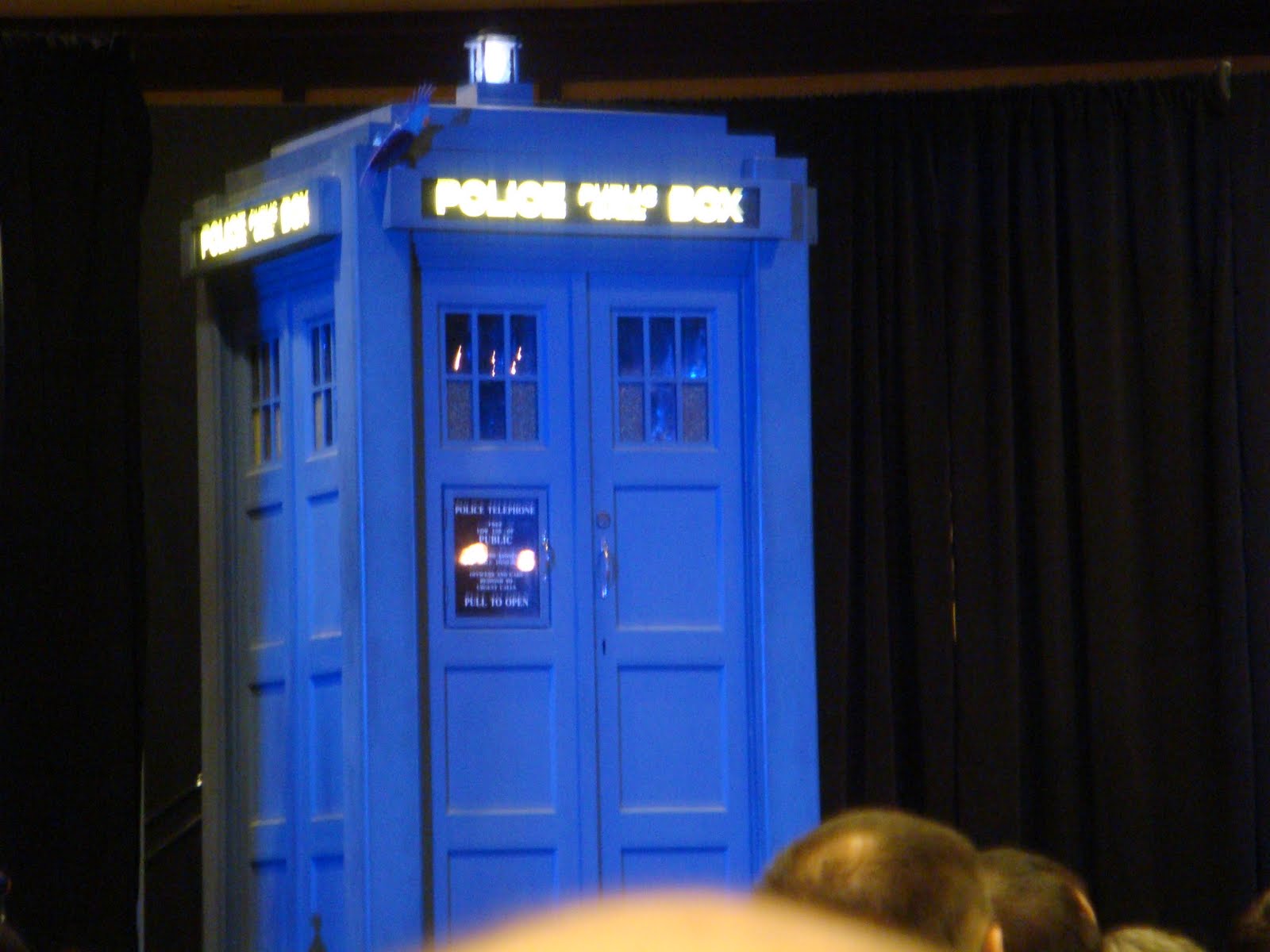
A couple of photos that illustrate the range of programming, covering both the original and current series:


Two actresses who played companions to The Doctor in the early '80's -- Sarah Sutton and Janet Fielding -- reminisced about their time on the series, a time when multiple recurring characters were jammed into short episodes, and as a result development of supporting characters was stunted. Both left full-time acting, and Fielding became an activist for better treatment of women in the industry, as well as a talent agent. We spoke to Fielding at the convention, and we could understand how she would do well as an agent: Not only is she smart and outspoken, but she developed an instant rapport with everyone with whom she spoke, treating them as old friends.

I also attended a panel that featured several of the behind-the-scenes people for the current series -- a producer, a writer, set designers and costumers. One of the major innovations of this series over the previous one, they revealed, was the institution of "tone meetings" -- in which an episode's writer meets with the director and the other creative minds behind the series; explains the tone and mood he or she wants to accomplish; and brainstorms how to bring that vision about.

Much like The Doctor himself, this convention continues on -- by reinventing itself.

Saturday, February 12, 2011

Bending for 45 Years


Thanks to the wonders of the Internet, I was able to reacquire one of my favorite toys of my childhood -- a bendable figure of the TV Green Hornet, vintage 1966.  It's not as flexible as it used to be.  But then, neither am I.

Wi-Fi (Maybe) Watering Holes: Balconi Coffee

Those who have been reading this blog for a while (and if you have, thanks) may recall that in its early years I often reviewed coffee joints in the L.A. area that provided free wi-fi. I've had fewer in recent times, because I haven't found many new ones, and several older ones I reviewed succumbed to an economy that encouraged folks to brew beverages at home. Plus, since Starbucks gave in and began offering free wi-fi last year, there's less incentive for independent coffee houses to distinguish themselves by offering the service.

I am happy, however, to report that one of my favorite WFWHs has come back from the great beyond. Two years ago, Cafe Balcony in Santa Monica lost its lease. Recently, it has come back as Balconi Coffee Company. Better yet, it is located in the Olympic Collection at Sawtelle and Olympic Blvds in West Los Angeles -- close to my office.

I'm hesitating to recommend it as a wi-fi watering hole, because I'm not sure if it offers wi-fi yet. Once it does, I'll be happy to add it to my WFWH list once again.

The King's Speech, and a Princely Task

Last weekend, we saw The King's Speech, which deserves the plaudits being laid at its feet (if a film has feet, and plaudits can be laid at them). It's a film that celebrates both the heart and the head. It concentrates both on play-like dialogue and cinematic storytelling. It's equally at home with tight closeups and epic abbey establishing shots. And it makes Americans cheer for the monarchy from which they fought to separate themselves over 200 years ago. (I'm sure there's many Americans who wish for a king, even a stammering one, especially if he looks like Colin Firth.)

Over on the Huffington Post, Monty Pythoner Michael Palin comments not only on The King's Speech, but on the stuttering character he played in "A Fish Called Wanda"; that character's origin in his own father; and how that role resulted in help for real-life stammerers.

Saturday, January 29, 2011

Evangelion: You Can (Not) Angst

Back in the fall of 2007, we were privileged to see EVANGELION 1.0: YOU ARE (NOT)ALONE in a theater in Ikebukuro, Tokyo, in Japanese sans subtitles.


The American anime licensing market has greatly diminished since that time; but I'm pleased to report that it is still mighty enough that this afternoon we had the opportunity to see the second chapter of the big-screen retelling of the Evangelion anime series, EVANGELION 2.0: YOU CAN (NOT) ADVANCE on the big screen at the Independent Theater in Downtown Los Angeles.


Seeing well-done anime on the big screen is generally a treat. And for a movie like this, which combines terrific character designs and giant armored organic warriors with fantastic redesigns and high-impact direction, there's no better place to watch it.

The story is, in some ways, the same strange amalgam of post-apocalyptic/pre-apocalyptic science fiction, study of teenage loneliness and neuroses, goulash of Judeo-Christian concepts, and eye candy that the TV series was, albeit writ larger and tweaked a bit with some rearrangements of events and at least one new character. I'm interested in seeing where the creators ultimately take the story, considering that we've had multiple endings before (one weird low-budget one for the TV series, and two previous movies that offered an alternate ending).

In any event, if you're interested in seeing some spectacular examples of Japanese animated science fiction, or if you'd like a look into the show that has been the epicenter of anime fandom for the past 15 years, I recommend watching the two Evangelion movies, either in theaters (if you can) or on DVD or Blu-Ray. Be warned: It's not for pre-teens; and there will be some images you will find hard to get out of your head.

Sunday, January 23, 2011

More Buzzing about the Hornet

This afternoon, I read a media tie-in from 70 years ago: a 1940 Green Hornet Better Little Book. Although it was written for children, and didn't have a huge amount of subtlety, it was fairly well written and told a complete story. It revolved around a special prosecutor who was gathering evidence against a protection racket, and his wastrel son who was vulnerable to blackmail because of his gambling debts. And also as in the movie, Kato is skilled in both sciences and martial arts (although the movie does not have Britt save Kato's life while Britt is traveling in the "orient," resulting in Kato coming back with him to serve as Britt's valet.). The book even has secretary Miss Case as someone who knows the newspaper biz better than Britt.

The big difference between this Hornet and Seth Rogen's: This Green Hornet is not an idiot.


- Posted using BlogPress from my iPad

Monday, January 17, 2011

Another Challenge for the Green Hornet


As a compromise, it's not that bad.

The GREEN HORNET movie that debuted Friday was the culmination of a decades-long push to make a movie based on this radio-show hero created in the 1930's. The challenges were understandable. Apart from various comic book appearances in recent years, and a scene in the 90's biopic about Bruce Lee, the Hornet has been absent from popular media since his ill-fated 1966-67 TV series. That he remains known at all by people who are not old-time-radio cognoscenti probably results from that sixties TV series -- my favorite incarnation of the character -- which, while hampered by low budgets, a half-hour format that pretty much prevented any character development, and a serious tone that bucked the campy superhero vibe of the day, still had style to burn, cool threads, some nice noirish mise en scene, and Bruce Lee as Kato. Other pluses are the unique concept that the Hornet is a hero posing as a gangster (which probably worked best in the thirties) and the Hornet's status as a major influence on that other pulp-fiction rich guy who rides around in a fancy car with his sidekick, wearing a mask, and dealing out late-night justice.

And I've got some emotional investment in this property. When I was a little kid, the TV series was playing in syndication; and for some reason, I was obsessed with it. I read over the Whitman novelization of the TV series. I sought out whatever merchandising I could find from that over-merchandised series. I played with Green Hornet bendy toys and threw a fit when I lost them. I ran around in a Green Hornet sweatshirt and my dad's hat, wielding a black plastic squirt gun as my Hornet Gas Gun. Years later, I watched episodes of the series; and while I cringed a bit at some of the cheap production values, I found them stylish and fun -- particularly Bruce Lee's fight scenes.

Which brings us to the compromise in question: The new GREEN HORNET movie.

The movie is plainly based more on the sixties TV series than the radio show (although in an early scene the Hornet and Kato wear outfits that suggest their '30's incarnations). We have the '65 Chrysler Imperial Black Beauty (which lives up to its name), the sixties costumes (which look rather retro now), D.A. Scanlon (a decidedly different character than his sixties character, who was a mentor to young Britt Reid and the Hornet's "inside man") and Lenore Case, Reid's blonde secretary (whom Cameron Diaz plays with particular snap and a great deal of tolerant patience). We've also got the elements the series carried over from the radio show: The Daily Sentinel newspaper (here depicted as housed in the CAA building in Century City), supposedly a family-owned major newspaper in Los Angeles not affiliated with a conglomerate (now there's a fantasy element); Mike Axford, an Irish reporter in the radio and TV series, now an editor played by Edward James Olmos; and a theme of Britt Reid trying to live up to his father's example.

The best new thing the movie brings to the party is the updated Kato. In the TV series, it was clear that Kato was the better fighter of the pair, and had so much to offer that his role as Reid's valet and chauffeur seemed demeaning even as a cover for his true job. Here, Kato is depicted as a real person, much (much much much) smarter than Reid, and actually the lead in the partnership. He also has feat of clay, including his machismo and frat-brother attitude that alternatively draws him into collaboration and conflict with Reid.

The movie also brings money -- money to create set pieces that the TV series could only dream of. We don't have to deal with "midnight" scenes that were plainly shot in sunlight, or the massive use of repeated stock footage, that the TV series used to stay within budget. Plus, the director brings a certain style to the proceedings that I prefer to some of the blurry-shot action scenes in recent movies.

The weak point is the Hornet himself -- at least, as portrayed by Seth Rogen.

Apparently, Rogen is the compromise. The only way this long-gestating project could see the light of day was for writer-star Seth Rogen to bring his fans (of which I am not one) by depicting Britt Reid as Seth Rogen's standard screen persona. That is, rude, clueless, and deliberately, achingly, stupid. I say "deliberately" because Rogen's Reid starts out the movie as a self-made idiot playboy (supposedly his rebellion against his emotionally abusive father), the son of a newspaper publisher who has never read a newspaper all the way through. And throughout his character arc, he . . . never improves. Even though he places himself in a situation where he needs quick wits to stay alive, he does nothing to quicken his wit. Even the scene in which he puts all of the clues together (accompanied by one of the most unnecessarily arty montages you'll ever see), the movie emphasizes how stupid he is.

Now, the Hornet was not necessarily a complex character, either in the radio show or in the TV series. So the filmmakers had some broad character outlines to fill in. But as opaque as Britt Reid/the Hornet were as characters, the one aspect of both that could not be denied was their intelligence. Reid was young in the TV series, and was constantly compared to his father, but he was plainly a sophisticated businessman who was always on top of his job. Despite his extracurricular activities, his role as a publisher was not just a blind; his journalism was another weapon in his war against gangsters or racketeers. Indeed, the radio Green Hornet often went after crooked businessmen, a task that demanded Reid's business acumen. As for the Hornet, he played a vital role in the crimefighting team: He was the one who came up with the plans and strategies, and who carried them off with the sangfroid that allowed him to swagger into a room of thugs wearing a mask and an attitude.

Moreover, intelligence is simply a prerequisite for a hero such as the Hornet, who doesn't rely on superpowers or bullets (well, at least the non-movie Hornet stays away from the bullets). You can have a hero who isn't musclebound, or who doesn't have the best fighting skills. But you cannot have a private-eye-type hero like the Hornet who isn't smart. Indeed, it's difficult for any hero to function without intelligence, unless he's the Hulk. (Who's also green.)

A Hornet who is stupid, who glories in his stupidity, who succeeds despite his stupidity, is simply not my Green Hornet.

So it's a pretty good Green Hornet movie, except for one pesky thing: The Green Hornet.
Sunday, January 09, 2011

Anime L.A. 2011

I've just come back from my first convention of the year -- Anime Los Angeles 2011. It's very nice of the convention to put together an event that has grown to (I believe) around 3500 attendees, yet still has a small-con feel to it. Not to mention having as guests two of the most personable and entertaining folks in the U.S. anime biz, Patrick Seitz and Taliesin Jaffe. Photos soon.

Friday, December 31, 2010

I Sing the Book Electric

I've had my Nook e-reader since November 2009, and my iPad since its April 2010 release, so let's round it out and say I've been reading e-books for a year. In addition to the Nook, and the Nook and Kindle apps on the iPad, I've got Nook and Kindle apps on my Droid phone, which are handy for pulling out a book when you're stuck somewhere.

In that time, I have read, to completion, around 14 e-books, mostly on the Nook. I haven't compared that to the number of non-work physical books I read in years past -- mainly because I usually don't keep track of such things. But my sense is that I am reading more now, in part because of the convenience: When I finish a book, I don't have to dig or shop for a new one; it's a couple of clicks away.

I've also switched from buying my family's books in physical format to buying them electronically. The tough part is getting them signed. Autographing electrons takes a very small pen . . . .

A Tron in a Much Larger Game

I'm diving into the holiday movie season, which is much like the summer movie season except with a little more lead-shot weighting at the bottom, Oscar noms being so close and all. As I write, I'm waiting at the Landmark Theater to watch the current adaptation of TRUE GRIT; and last weekend I saw TRON LEGACY at the Majestic Crest Theater.

What can I say about a sequel/reimagining of a 28-year-old movie that I didn't care for when I saw it? Well, I liked it better than I liked the original. The original came out at a time when Disney was trying for slightly more edgy live-action movies than the family fare for which it had become known. It had not yet formed its Hollywood Pictures branch; this was more the CONDORMAN era. TRON therefore had the feeling of a studio groping for a style and failing to really achieve it. I wasn't wowed by the graphics; and without the graphics there was just the novelty of people pretending to be computer programs, on dark soundstages in neon clothes.

The 2010 TRON seems to have more of a storytelling flow, although it, like the original, is choppy in places. Logic ebbs and flows, and a lot of the technology explored in the story has to be taken on faith (kind of like the tech in INCEPTION) because there's no effort to explain it that makes any kind of sense.

But what the movie does have going for it is some humanity in the tripartite relationship between Jeff Bridge's Flynn, his son (the protagonist) Sam, and CLU -- a computer avatar of Flynn who has captured Flynn's world view at a young age, and has not let it go. In contrast to the older Flynn, CLU does not learn with age. So we have a sort of family drama with son, dad, and dad's obnoxious brother. Oh, and there's Quora -- Olivia Wilde, buffed out, mascaraed, and sealed in a skintight suit -- who is the only female character with any depth and therefore must fulfill all the roles permitted to women in a boy's adventure movie: Little sister, warrior babe, foundling, victim to be protected, and love interest. She must be exhausted.

Since it's a special effects movie, the story devotes little time to exploring the family dynamic (and probably too much time, to the folks who want to see light cycles blow up). But it adds a bit of substance to the eye candy of the CG, and the delight of a world where you can leap into space and form a light-jetplane around yourself.

It makes for a fun time in the theater, and a pretty experience for your eyes. But not necessarily a best picture nomination.

Saturday, December 18, 2010

'Tis the Season

Here are my recommended gifts for the season:

-- Charity gift certificates. Literally the gift for the person who has everything. You give the recipient a certificate he or she can use to give a charity of the recipient's choice. My favorite provider is Seattle's Tisbest (www.tisbest.org).

-- Books. The bookselling industry (and, by extension, the book publishing industry) is in trouble. Buying from independent bookstores is good, but even giants like Barnes & Noble and Borders are suffering.

-- DVDs/Blu-Rays. Video sellers are also in trouble. Blu-ray discs are an especially appropriate gift for folks who have PS3s or one of the blu-ray players that have gone way down in price.

Sunday, December 12, 2010

Warriors. Way.

There's nothing new or innovative about the peanut-butter-and-chocolate melding of westerns and eastern martial arts. The cultural cross-pollination between westerns and samurai movies starting in the fifties, the contribution of asian immigrants to the building of the west, and the ubiquity of westerns during the time that kung-fu became popular in Hollywood, have all contributed to a half-century of martial arts westerns. Certainly anyone who watched TV in the seventies -- or who has watched reruns from that era -- recalls "Kung Fu," the most popular martial arts western in the U.S. And Asian countries have contributed to the subgenre, with works such as the 1985 anime movie "Dagger of Kamui" in which a gold hoard from Catalina Island funds the overthrow of the shogunate.

So there's nothing new about "The Warrior's Way" in terms of theme. What's new are the technological innovations that make what would otherwise be a cheap B-movie into something that's visually entertaining -- sort of a live-action anime -- particularly the scenes with the ninja-like warriors dropping from the sky like black rain. And what would otherwise be a matte-painting background is now a digitally-painted background, unreal and real at the same time.

There's not a lot of brain power in "The Warrior's Way." The filmmakers don't bother to give most of the killed bad guys any personality. Neither do they explain what country the protagonist or his opponents come from (Korea? China? Japan? Some mythical amalgam of them?) or how literal armies of warriors can be brought across the desert or across the ocean. (How are they billeted? Provisioned? Paid?) But it's a fun weekend afternoon of martial arts, six-shooter entertainment.

Sunday, December 05, 2010

Hey Kids! Free Books!

For those who have just obtained Kindles, Nooks, or iPads, and are looking for ebooks to put on the devices, I heartily recommend the Baen Books Free Library of ebooks. (http://www.baen.com/library/) These are science fiction books that the authors or right-holders have elected to offer for free, either as the initial books in series or as examples of the authors' work. And these authors aren't z-list; they include some of the biggest names in science fiction -- such as Larry Niven, Andre Norton, Lois McMaster Bujold, and Keith Laumer. They're available in a variety of formats, so that you can read them on most devices. You can even read them online without downloading them, if you choose.

Saturday, December 04, 2010

Desert Trip

Today, we took a road trip down to Rancho Mirage to visit Dad and Regina, along with my brother Steve and my sister-in-law Dawn. Along with a great dinner at Roy's Hawaiian Fusion, one of the highlights was Dad reading aloud from his book, while Steve and I took turns videoing him.

Here's some footage of Dad reading about his parents' courtship:


Watch "Dad reads a story from his book." on YouTube

Update: Dad's book is now available on Lulu.com as a paperback for $9.02 (http://www.lulu.com/product/paperback/a-barer-blog-posts-2006-2009/13049205?productTrackingContext=search_results/search_shelf/center/1) and as an ebook for 99 cents (http://www.lulu.com/product/file-download/a-barer-blog-posts-2006-2009/13049206?productTrackingContext=search_results/search_shelf/center/2) We are making the book available at cost.


- Posted using BlogPress from my iPad

Sunday, November 28, 2010

Loscon 2010

This afternoon, we wrapped up our three-day attendance at Loscon, the annual science fiction convention of the Los Angeles Science Fantasy Society, the oldest science fiction club in the world. Although we've attended many Loscons in the past, the 37th one was marked by Amy's local debut as a dealer in the dealer's room. She ran a table for her embroidery company, Heart of the Star. She set up one of her computerized embroidery sewing machines at the table, along with a laptop and monitor so folks could see the designs take shape on the screen. She also sold patches and pieces of lace. Most important, she gave out business cards inviting people to give her commissions. And a lot of people showed interest in the prospect.

Naturally, I helped set up and break down the table, and worked the table along with her. Working a convention as a dealer solo pretty much guarantees you won't be able to see any of the convention's daytime events, so a partner is invaluable. You must still pick and choose the events you will attend, since only one of you can attend at a time. That meant about one panel per day for each of us.

The success of a convention depends largely on the caliber of the guests. This con had excellent luck in that department. The themes for this year's Loscon were steampunk, urban fantasy, and SF Noir. Writer Guest of Honor Emma Bull covered the urban fantasy ("War for the Oaks") and SF Noir ("Bone Dance") categories, while art guest of honor Phil Foglio ("Girl Genius") handled the honors for steampunk. Ms. Bull's services as a GOH came with a bonus, since her husband, writer Will Shetterly, came too and appeared on several panels. Further, the programmers did not repeat the mistakes of past Loscons, which did not know what to do with their art guests. Aided by Foglio's talent as a writer and entertainer along with his artistic skill, the programmers put him on multiple panels.

The convention themes were also well-chosen. Due in part to LASFS's venerable status, the convention attendees tend to skew older. (A telling comment from one participant to another during a first-day panel: "Will I be as bitter as you when I get old?") But since steampunk is au currant with younger fans, the theme brought in some fresh blood as folks who never attend Loscons descended on a dealer's room stuffed with top hats, goggles, pocket watches and gears.

The conventions I enjoy most are those at which I can talk to people. At this con, I had the chance to hobnob with folks that span the multiple decades I've spent attending California conventions. That's particularly nice when spending a lot of the convention behind a dealer's table.

We've reserved a table for next year, so we'll be doing it again in 2011.

Sunday, November 21, 2010

Hallow Hallow

I'm positive that a certain percentage of the massive moviegoing crowd descending upon theaters to watch HARRY POTTER AND THE DEATHLY HALLOWS has neither seen any of the previous movies nor read any of the novels, and will wander out of the theater wondering, "What the hell was that?"

Because the filmmakers aren't wasting any time trying to orient folks watching this for the first time. It's too late for that, so you either grab on and enjoy the ride or get flung off.

The DEATHLY HALLOWS is one of the best of the film series. Not only has director David Yates (who directed the previous two movies as well) found his storytelling tone for this movie, but the film benefits greatly from three developments. One is cutting the final Potter novel into two parts, allowing time for this movie to actually tell a cinematic story rather than be consumed by the labrythine plot. Another is that the characters and cast have become young adults -- which makes some of the plot developments and scenes a lot less creepy (in the non-entertaining sense) than they would otherwise be. And finally, the story breaks away from that damned school, allowing Harry, Ron and Hermione to traipse and apparate over the length and breadth of England, from the heart of London to the cliffs of Dover, as they become a guerilla band of resistance fighters, sort of Harry Potter and His Hogwarts Commandos.

Another great touch is a scene in which Hermione tells a folk story integral to the plot, which the filmmakers depict in animation which recalls shadow puppets and El Greco art.

And the production values are stunning. Little expense has been spared, with a cast of thousands including lots of characters from previous movies.

Unfortunately, the slow, depressing segment of the novel -- in which the characters wander around, accomplishing nothing but getting on each other's nerves -- is here in its entirety, just as slow and just as depressing. True, there's some quality character development in the segment (one scene with Harry and Hermione, added for the movie, is just delightful). But it's a bit of a slog. Fortunately, the action scenes more than make up for the slow sections. (The segments with Voldemort's giant snake pal, Nagini, are truly cringeworthy.)

We saw the film at a 9:30 a.m. Imax presentation. The presentation was sold out. To me, that indicates the film is going to make a huge chunk of change this weekend -- as will the final film this summer. But the folks watching this won't care. They'll just enjoy a well-made fantasy adventure.

Saturday, November 20, 2010

Bay Area Vacation Photos


As promised, here are photos from our trip -- including the ones I took during our boat trip out to the Farallon Islands.

http://www.facebook.com/album.php?aid=38694&id=100000277390964&l=6fac2eb774

Tron Shop

This afternoon, we had lunch at Royal/T Cafe, the maid cafe/art space in downtown Culver City. The cafe was abuzz because Disney had opened a sleek TRON LEGACY pop-up store (http://nerdreactor.com/2010/11/19/tron-legacy-pop-up-shop-grand-opening/) there.

After eating a couple of "Reco Burgers" (buffalo burgers with fried onion rings, and circuitry drawn onto the plate) we toured the shop. The store and the merchandise look very sleek, all black surfaces and blue neon lights. We didn't buy anything, however. I kept in mind that stuff that looks shiny and slick on the shelves may not look as nice a few months or years after it lands in your closet. Besides, I saw the original TRON in theaters back in the eighties, and was unimpressed. It's possible that this sequel, despite all the buzz, won't reach its full charge when it comes out. And if any merchandise looks especially tempting, it may be available on eBay for pennies on the dollar.

Nevertheless, I was happy to see the business and publicity the store generated for Royal/T. It's a great place, and I don't want to see it fade away.

Wednesday, November 10, 2010

Back from the Bay

We are back from our shark vacation to the Bay Area. Alas, we saw no sharks -- apart from the ones at the Fisherman's Wharf aquarium. During our Saturday trip to the Farallon Islands, we saw whales, seals, jellyfish, and amazing scenery; but the sharks were laying low. And our second trip (on Monday) was canceled due to high winds at the dive site.

Still, we had plenty to do during our trip. We were blessed with lots of sunshine (which, in true Bay Area style, occasionally turned to fog or pouring rain in the afternoon). We relived some of the experiences of my law school years in San Francisco by taking outings to the Wharf, Japantown, and the Haight. We met Walnut Creek cousin Steven Barer and his family. We had a dinner at Chez Panisse, the home base for California Cuisine. We encountered multiple persons with altered mentation.

I'll put up some photos soon.

Sunday, November 07, 2010

Goodbye to Jan

My cousin Jan Curran was laid to rest this past week. I was always impressed with her sophistication and wit. To my knowledge, she was the first author in our family to have a book published. I remember my excitement when I attended a book signing she had in Walla Walla in the mid-70's for her self-help book about coping with divorce, "The Statue of Liberty Is Cracking Up." Incredibly, each of her four children grew up to become published authors. In fact, the last time I saw Jan was at another book signing, this one held for her son Tod's latest book. And at that signing, Jan was grieving over the passing of her own mother earlier that day.

I've been watching the Japanese animated series "Tegami Bachi," in which one of the underlying conceits is that a person's humanity, or "heart," is a quantifiable and finite energy, and that letters or other writings are like batteries that store within them the "heart" of the person who writes them -- an energy into which the reader taps. Jan undoubtedly poured a lot of her heart into her writings. And her writings remain -- on her blog, in her Facebook posts, in the two books she wrote, and in her children's writings. The ability to preserve the energy of humanity through writing is one that should never be taken lightly. It allows portions wonderful people like Jan to remain after they themselves have left us.

http://abarer.blogspot.com/2010/11/reflecting-on-passing-of-cousin-jan.html
- Posted using BlogPress from my iPad

Friday, November 05, 2010

Vacation, Had to Get to Bay

I'm finishing up Day 2 of our Bay Area vacation. Yesterday was spent kicking back and walking around the waterfront near our Berkeley marina hotel. Today we picked up a wetsuit for Amy in San Francisco, which she'll use tomorrow when we go out on the first day of our two-day shark-watching adventure.

We indulged in touristy stuff in San Francisco: We BARTed into town and took a cable car to and from Fisherman's Wharf. Since I lived in SF during the late '80's, and my last couple of visits have been for business purposes, I found doing the tourist thing in the city amusing.

Tomorrow: The sharks.

Saturday, October 30, 2010

"A Barer" Blog Posts Collection Now Available

"A Barer: Blog Posts 2006-2009" -- a collection of excerpts from my dad's blog -- is available at:

http://www.lulu.com/content/paperback-book/a-barer-blog-posts-2006-2009/9199980


We haven't put any markup on the book; Lulu.com is the only party making money on it. A hard copy of the book (perfect-bound trade paperback) is $9.02; an ebook version (pdf) will set you back the princely sum of 99 cents.

Obviously, I'm biased; but when I pick a copy up and read it, I find it hard to put down. It's filled with anecdotes about our family; about Dad growing up in Walla Walla, Washington; about the famous people Dad has known; about the various personalities who have worked at the family business; and about life in general, from someone who has lived it.

For samples, see Dad's blog at www.abarer.blogspot.com

The Mystery of Muscle

I'm a sucker for the COMIC BOOK LEGENDS REVEALED column on the Comic Book Resources Website, which inquires into the truth or falsity of various urban legends about comics. (Those do tend to proliferate in the age of the Internet.) The current installment at
http://goodcomics.comicbookresources.com/2010/10/29/comic-book-legends-revealed-284/ explores the legal fallout from Flex Mentallo, Man of Muscle Mystery, Grant Morrison's sly parody of the Charles Atlas ads which appeared in DC's Doom Patrol comic in the early '90's. It amused me when it came out. It did not amuse the Charles Atlas company.

- Posted using BlogPress from my iPad

Sunday, October 17, 2010

My Father Makes (a) Book

In the benign sense of the phrase.

I've been working on compiling posts from my father's blog (http://www.abarer.blogspot.com/) into a paperback book, published on Lulu.com. An initial edition was not formatted to my tastes, and so I spent this afternoon reformatting the manuscript and uploading it.

If this edition is satisfactory, I'll post the URL for purchasing the book. We will be making it available at cost, with no markup.

Just a few years ago, putting together this sort of project would require paying hundreds or thousands of dollars to a publisher or "vanity press"; and the result would be an ungainly-looking pamphlet. Today, a service such as Lulu.com provides the software tools for putting together a professional-looking perfect-bound paperback, with a color cover, for no money upfront. Money is paid only when a book is ordered and printed.

In an era in which the entire traditional book publishing and distribution industry is in jeopardy, I'm glad that services such as this are available to help people preserve history via the written word.

Saturday, October 16, 2010

Releasing the Unreleasable

Warner Communications is a conglomerate that certainly doesn't need my endorsement. But I do want to plug one of their little-publicized projects: Warner Archive.

http://www.wbshop.com/Warner-Archive/ARCHIVE,default,sc.html

The Archive takes movies and TV series from the Warner Archives that have never been released on DVD (presumably due to lack of perceived interest) and offers them as print-on-demand DVDs, complete with professional packaging. So far I've obtained from them the 1975 Doc Savage movie ( which I had to watch to confirm my memories of how bad it was) and a complete collection of the Thundarr the Barbarian cartoon from the early '80's, which featured character designs by Alex Toth and Jack Kirby and scripting by Steve Gerber, Roy Thomas and other comics writers. A DVD of Hammer's version of SHE, with Ursula Andress, is on its way. Check it out and see if there's some half remembered treasure you'd like to own on DVD.

- Posted using BlogPress from my iPad

Sunday, October 10, 2010

Drawing Batman

As someone who has read and collected Batman comics for decades -- and who has read many Batman comics stories published before he was born -- I have to say that many current comics artists simply do not "get" Batman. The Batman is one of the best-designed superhero characters of all time. That's plain from the number of consumers who have never read a Batman comic, and perhaps have never seen the character's 1960's TV show or all of his various animated incarnations over the last 45 years, yet are drawn to T-shirts or toys or other merchandise bearing his image. Batman, when drawn right -- with the right balance of shadow and light, fluidity and solidity -- looks cool. No matter that a Dick Sprang Batman from the mid-fifties is drawn in a completely different style from a Marshall Rogers Batman from the mid-seventies, or that a Jerry Robinson Batman from 1942 does not look exactly like a Carmine Infantino Batman from 1967. When the artist gets it right, you know it's Batman.

Unfortunately, many artists these days don't get it right. They have the necessary costume elements there; but it's not Batman. It's a character in a Batman suit. That doesn't mean the art is necessarily bad. They just don't get the character right.

What a treat, therefore, that the week of October 7, 2010 brought two new comics from artists who know how to draw Batman -- artists who first became known for drawing the character around 40 years ago.

One of the comics was issue #4 of BATMAN ODYSSEY. ODYSSEY is an extraordinary monthly series written, pencilled, and in its first two issues inked by my favorite Batman artist, Neal Adams.


Adams intends ODYSSEY as his definitive take on the character. I take some issues with his vision of Batman: Chatty, somewhat smart-assed, and wearing his emotions on his sleeve. That's particularly true in this issue, in which he thinks a criminal has killed a little girl that he was protecting, and he proceeds to pound the guy into hamburger while Commissioner Gordon and his cops try to talk him out of killing the man. (And I won't get into Adams's mulleted Aquaman.) But I have no complaints about the art, which not only equals the work Adams did from the late '60's to the early '70's on Batman but surpasses it. Even more extraordinary -- both for Adams, given his track record, and for modern comics in general -- is that each monthly issue has come out on time.

The week also brought a nice presentation of an inventory story (from an unspecified year -- although, from the art style, I believe it would be the early '90's) by Bernie Wrightson, ably inked by Kevin Nowlan.


This treat is accompanied by a reprint of Wrightson's first Batman story, a 1973 issue of his and Len Wein's SWAMP THING series, with an appreciation by Wein at the end. In this case, the art in the earlier story is better, in my opinion, than in the later Wrightson tale. But that does not lessen the fun of reading a comic in which the artist gets Batman right.

Fans who have read the character only in recent years may take issue with my preferences. That's fine. Batman is a resilient enough character to accommodate many artistic visions. But I'm glad that I can occasionally see new comics featuring Batman.

Sunday, October 03, 2010

Identity-Less

I've been enjoying Gail Carriger's Parasol Protectorate series of steampunk novels quite a bit. I've read the first two entries in the series (SOULLESS, released in 2009, and CHANGELESS, released in 2010) and have the latest, BLAMELESS, sitting on my Nook ready to read. The books take the approach (interesting if done right) of analyzing a fantasy conceit through the science fiction lens, and conveying it all in a tongue in cheek, hyper-Jane-Austin style that is a lot of fun to read. So much so that I don't even mind that it incorporates one of the current fantasy cliches, vampires vs. werewolves (although here, the conflict is more in manners than in tooth vs. claw combat).

So I found the interview with "Ms. Carriger" in the current Locus magazine interesting. Not only did the author create Gail Carriger as a pseudonym (due to her involvement in academia when formulating the series), but she has created an entire persona around the nom de plume. When she makes appearances as Carriger, she dresses in more vintage clothes, and adopts a more Anglicized and mannered conversational style than normal. Her stated goal is to create Gail Carriger as a brand. And it is working. CHANGELESS debuted on the NY Times bestseller list, as did BLAMELESS last month.

It's no secret that an author's public persona can be an effective marketing tool, particularly when the author is an entertaining bon vivant or a fun curmudgeon. To what extent can a persona be created as an advertising tool -- particularly where, as here, the author's true identity and the persona's creation are open "secrets?"

Saturday, October 02, 2010

Stephen J. Cannell

Perhaps the most graceful way to deal with a death is to write with joy about that person's life. That is what my cousins Lee and Tod Goldberg have done to address the passing of Mr. Cannell.

http://leegoldberg.typepad.com/a_writers_life/2010/10/remembering-steve.html

http://todgoldberg.typepad.com/tod_goldberg/2010/10/stephen-cannell.html

- Posted using BlogPress from my iPad

Sunday, September 26, 2010

The Open Road; The Open Mouth

On Saturday night, I enjoyed a double feature of two Alex Cox movies: REPO MAN, from 1984, and SEARCHERS 2.0, from 2007. In between, three actors who are in both features (Del Zamora, Ed Pansullo, and Sy Richardson) along with fellow RM actors Dick Rude and Olivia Barash did a Q & A with the audience; and the three SEARCHERS actors stuck around through the second feature and chatted with the audience in the lobby.

SEARCHERS 2.0 is, in some ways, the stereotypical indie movie. It's shot on a tiny budget, on HD video, and is mostly talk. And talk. And a bit more talk. Fortunately for both the movie and the audience's sanity, the talk is fun and entertaining, and the characters just the right mix of sympathetic and obnoxious that we don't mind spending 93 minutes in their company.

The basic story would fit on the back of a cereal box. Two former kid actors from Western movies learn that a screenwriter who once abused them on a movie set will be appearing at a film screening in Monument Valley. They immediately embark on an Ill-thought-out mission to drive from L.A. to the valley and take revenge on the writer. Because they must take the SUV of the daughter of one of the actors, the daughter comes along on the trip. The actors engage in endless discussions about American films, primarily westerns about revenge. The daughter -- who rereads "The Fountainhead" obsessively -- alternately complains about the conversation, or critiques the underpinnings of American films. It's all fairly straightforward, but takes a Cox-like surreal turn when they get to Monument Valley. It's not entirely satisfying, and certainly not a work that captures the zeitgeist like "Repo Man" did 26 years ago. But it's certainly worth a viewing when it comes out on video next month -- particularly if you're a movie fan who can stand to see your favorite movies take a little needleing.


- Posted using BlogPress from my iPad

Happy Birthday, Dad!

Friday, September 24, 2010

Sunday, September 19, 2010

It's a Melody Played in a Penny Arcade.

Don't get me wrong. I'm grateful that Los Angeles has a public radio jazz station, KKJZ, allowing me to listen to jazz all day at work. But I do think the station's programmers have to acknowledge that there has been new jazz music composed in the last 30 years. K-jazz's programming consists of old performances of old music, and recent arrangements of old music. I like the jazz music of the past. But the genre is still alive. I wish the station would treat it as such.


- Posted using BlogPress from my iPad

Saturday, September 18, 2010

To Catch a Thief, Go North by Northwest

On Friday night, I played hookey from Yom Kippur evening services and Amy and I headed to the Aero Theater, where American Cinematheque is in the middle of a Hitchcock tribute. Friday's double feature comprised two of the movies Cary Grant made with Hitchcock: NORTH BY NORTHWEST and TO CATCH A THIEF.

NORTH BY NORTHWEST is my favorite Hitchcock movie. I have it on laserdisc, and I've seen it several times. I'd seen TO CATCH A THIEF once, on a pan-and-scan VHS cassette with bad Copyguard problems (the top of the frame skewed to the left). I didn't recall much from it, except that when I rented it I mistook it for the similarly-titled 1960's TV series, IT TAKES A THIEF.

Seeing NORTH BY NORTHWEST on the big screen was a delight (even though we had bad seats -- to the left of the screen, and close up) and brought out how painterly the late '50's Technicolor could make a movie. TO CATCH A THIEF also looked great on a big screen, especially since so many of the movie's charms are visual. THIEF doesn't have the action or suspense that NORTHWEST packs; but it has beautiful scenery (the French Riveria, with lots of helicopter shots of the hills and water), beautiful costumes (from Edith Head -- when the plot calls for an 18th-century-themed masquerade, the camera lingers on the details of each period costume), and beautiful people (Grant and Grace Kelly, who met her future husband during the movie shoot).

While Grant does get to look Ninja-cool in THIEF, decked out in black and lurking on rooftops, nothing compares with NORTHWEST, the movie that influenced all the spy flicks and TV series in the '60's. NORTHWEST even boasts actors who would later be in three of the top spy series of the swinging sixties: MISSION:IMPOSSIBLE (Martin Landau), GET SMART (Edward Platt), and THE MAN FROM U.N.C.L.E. (Leo G. Carroll).

As an added treat, Eva Marie Saint strolled onto the stage at the front of the Aero Theater between movies, to answer questions about her role in NORTHWEST and other movies. Ms. Saint was all old-school-movie-star charm and dry wit. And her looks prove that fine cheekbones survive the decades. ("No Botox!" she exclaimed.) She discussed tidbits about the production, such as how Hitchcock avoided contemporary fashions in his movies because he thought nothing "dated" a movie worse than clothing. Another is that the Wright-type house on top of Mt. Rushmore in the movie didn't exist in real life. It was just a painting on a scrim on the soundstage. The Mt. Rushmore face on which the actors crawled in the climax was also a soundstage mockup -- although high enough up that there were padded mats on the floor to catch the actors if they fell.

The demand for this showing was so high that the theater was filled and many people were turned away. (And the Aero is a fairly large theater.) Just goes to show that well-made movies on the big screen can still pack 'em in.

Saturday, September 11, 2010

Wi-fi Watering Holes: The Talking Stick


A bohemian vibe permeates this coffeehouse, built in what appears to be a former diner space in a Lincoln Boulevard stripmall. You've got your standard mismatched chairs, tables, and couches. You've got a fairly large stage in the corner, with a nice sound system. You've got art on the walls. In addition, there's a used book shop/exchange in a side room (with stuffed chairs for comfortable reading) and an upstairs meeting room. Oh, and the coffee and the wraps are pretty good. Recommended.

http://www.thetalkingstick.net/

Travels with iPad

I've just returned from a three-day business trip. And while it's certainly no substitute for Amy, I found my iPad a most accommodating travel companion. When I wanted to read, it gave me novels and comic books. When I wanted to watch TV, it gave me streaming anime fresh from Japan. It provided me with music on command. And when I needed to work, it swallowed two-foot piles of trial transcripts (without showing the slightest bulge) and provided them to me in full-sized pages that looked clearer than the paper originals.

I did supplement the iPad with my netbook, because the Pad doesn't do WordPerfect and isn't great for typing. But the Pad provides.


- Posted using BlogPress from my iPad

Monday, September 06, 2010

Pierce the Heavens

I've been watching Japanese animation for a few decades now, and occasionally I'll get so weary of the more mediocre and repetitive products of the anime industry that I'll be tempted to think the industry's best days have ended. Then I see a series like 2007's GURREN LAGANN, which takes a concept as shopworn as giant combining robots and turns it into a brilliant work of storytelling, filled with emotion and wonder (not to mention quite a bit of silliness).

GURREN LAGANN doesn't look quite like any TV anime before or since. It starts out featherweight and then keeps spiraling (pun intended) into something that touches on the profound -- without ever growing ponderous.

And fortunately, the series is available online at Hulu.com:

Not Quite Despicable

DESPICABLE ME is a minor computer-animated work -- certainly not on the level of the Pixar or Shrek films -- and features some lamentable lapses in logic. But for what it is, it's well executed, and certainly a pleasant way to pass 90 minutes.

Sunday, August 29, 2010

Scott Pilgrim vs. Movie Audiences

We saw SCOTT PILGRIM VS. THE WORLD last night, and had a great time. I wouldn't want every movie, or even every comic-book adaptation, to be like this; but as a stand-alone cinema experiment, it worked nicely.

The movie essentially handles the ups and downs of a relationship between two young people (and the others in their lives) as an exercise in video game reality. Thus Scott must do more than compete with his new girlfriend's memories of her various exes; he must actually battle and vanquish them. And, without explanation, they and he have the sort of superpowers, battle abilities, and resilience seen only in video games and superhero comics. That results in a quirky mixture of honest human interaction and over-the-top stylized violence, complete with jump-cut editing, written-out sound effects, and real-life manifestations of cartoon symbols for emotion (a girl literally has stars in her eyes; a face turns into an emoticon).

It's well-done and well-acted enough that it veers more toward entertainment than annoyance. I hope this film has a second life on video.

Wi-Fi Watering Holes: Priscilla's Gourmet Coffee & Teas

We visited this charming WFWH (http://www.priscillascoffee.com/)this morning on our way to the Vintage Textile & Clothing Show in Burbank. A testament to how popular this place is: With a Starbucks catty-corner from it, and the historic Burbank Bob's Big Boy a couple blocks away, Priscilla's was still filled with customers on a Sunday morning.

Besides a menu filled with specialty espresso drinks, coffee and tea, Priscilla's looks great, albeit femine, inside. A mural of a provincial country scene winds its way between wall-filling shelves stocked with colorful gift tumblers. An alcove is stuffed with bins of coffee beans, a wall of teas, and a greaseboard with a dizzying list of coffees for sale by the pound. I imagine Priscilla's is popular with industry types, since Warner Brother's Studio is down the street and Disney a few miles west of that.

Sunday, August 22, 2010

Dreaded Deadline Doom

Entertainment guru Mark Evanier posted on his blog an excellent essay on deadlines ( http://www.newsfromme.com/archives/2010_08_15.html#019381 ) and an equally excellent follow-up (http://www.newsfromme.com/archives/2010_08_21.html#019401). They contain several solid recommendations -- backed up by the sort of anecdotes a professional storyteller delivers best -- but the central message is that no matter how brilliant your work is, if you can't turn it in by the assigned or promised date, you're unlikely to get the next job.

This advice applies not only to creative work, but the perhaps-less-creative field of Law. In law, blowing deadlines can have consequences far more serious than losing future work (although that can happen too).

It's also important to remember that reliability doesn't just mean meeting the deadline. It also means turning in good work at the deadline. Two deadline risks are presenting ineffective work product at the last minute; and what I call polishing the fire engine while the alarm is ringing -- revising and revising a project to make it as good as it can be, which can ironically result in more errors since the project can't be checked before it's turned in.

All this means that a person should learn that person's abilities and realistically assess how long a project will take -- which is what Evanier recommends in his second post. That's what enables people to turn in good work on deadline. That's one of the hallmarks of a professional.

Lean Times for Japanese Animators

The L.A. Times published this piece (http://www.latimes.com/business/la-fi-japan-anime-20100819,0,7946983.story) about the low wages animators in Japan earn ($10,000 a year on average -- and, having been to Tokyo a couple of times, I can attest that you can't live very well there on $10,000 a year) and the trend toward outsourcing. There's not much new about this news: Animators have likely been making low wages there for decades; and I heard back in the '80's that Japanese studios were outsourcing to Korea the animation that American animation companies outsourced to Japan.

What is news is the threat this poses to the industry's future. Both outsourcing and low wages are shrinking the number of experienced animators. (I suspect that the number of anime artists who can do completely hand-drawn animation -- as opposed to the computer ink-and-paint process that has been in place since the 1990's -- is shrinking as well.)

I wonder if at some point Japan will change its economic model for anime. It needs to take the money all the ancillary merchandising makes for the rights owners and channel more of that yen to the folks who create the actual animation.

Saturday, August 14, 2010

Miyazaki Minus the Magic

TALES FROM EARTHSEA, Goro Miyazaki's adaptation of Oregon SF author Ursula LeGuin's Earthsea stories, is finally playing in the U.S., three years after its debut in Japan. (The reason for the delay: SyFy Channel had the exclusive U.S. rights to the Earthsea stories until this year.) And one of the five theaters in the U.S. showing the movie is the Landmark here in West L.A.

I wish I could recommend that you run out and see it if it's playing near you. Unfortunately, I can't. I saw the movie on a DVD I picked up during our 2007 Japan trip (thank you, Disney, for putting English subtitles on the Japanese DVDS of Studio Ghibli movies); and found it drained of most of the magic prevalent in the anime made by Goro's father, Hayao Miyazaki. I blogged about TALES OF EARTHSEA here (http://barercave.blogspot.com/2008/02/nausicaa-vs-gedo-senkai-atonement.html)

It's great to see anime on a big screen. And EARTHSEA does boast character designs based on the elder Miyazaki's art. But EARTHSEA serves primarily as a reminder of everything extraordinary about Hayao Miyazaki's movies -- because all of that is missing from EARTHSEA.

Sunday, August 08, 2010

How I Spent My Saturday Afternoon

No real need for me to blog in detail about the Golberg book signing I attended yesterday, since my cousin Burl has already done so. http://adoraburl.typepad.com/burl_barer/2010/08/psych-monk-burn-notice-goldberg-rabkin-goldberg-talk-tieins-and-success.html#tp

I got there late, and so missed the picture-taking.

I did, however, make sure Burl was included in the book-signing magic by bringing two rare tomes for his signature: His 1994 book about the MAVERICK movie and TV series; and his 2006 novelization of the movie STEALTH, which was published only in Japanese. (I showed him where his name was spelled out in Katakana.)

Whither Wi-Fi Watering Holes?

Folks who have read this blog for any length of time may recall my fondness for coffee houses that have free wi-fi. They furnish a nice oasis for work if I have to toil over the weekend -- I can take a trip out and still get work done. I haven't blogged about them for a while, because I haven't discovered any new ones of note recently.

If this article (http://www.latimes.com/business/la-fi-cafe-wifi-20100808,0,2492467.story) is to be believed, coffee houses have been unplugging free wi-fi en masse, because (a) folks abusing the privilege hog long tables all day long, depriving other potential customers of places to sit, sip, and sup; and (b) now that Starbucks offers unlimited free wi-fi (as of last month), offering the same service is less of a customer draw.

Of course, there's some reason to doubt that the trend is as widespread as the article suggests. Although this is a Los Angeles Times article, the article does not list many L.A. coffee houses that are turning off the wi-fi and turning out the users. The reporter goes as far afield as San Francisco and Seattle to find examples. That suggests the reporter is inflating the significance of what he's reporting a bit.

And any article that features a college professor expounding, "The coffeehouse is a manifestation of our desire for that connection to community and more vibrant life than in our homes," is probably just an attempt to fill column inches on a Sunday.

Venice Beach in August

This morning, I rode my bike out to Venice Beach. Amy and I brunched at the Sidewalk Cafe, and then strolled the beach just as the sun came out. It takes moments like these to remind us that, yes, we do live on the Pacific Coast.